Forty five lakh for one machine.
That was the price of a New Holland backhoe loader. Over my sales career my team put more than ninety of them into the field in Nepal. Not a small operation. Also not the brand contractors named first, and that mattered far more than the price ever did.
The team ran the full playbook. The same playbook coaches run today when they go looking for coaching clients in Nepal. Facebook group sharing. Boosting. Bulk SMS to contractor lists. Every reach tactic the marketing blogs recommended, run properly and run consistently.
Attention came. Nothing moved.
It moved the day someone picked up the phone and talked to a contractor about the job he was struggling to finish. Not about the machine. About his site, his deadline, the breakdown that cost him eleven days last monsoon. The offer only got interesting after he believed the person calling understood his problem better than he understood it himself.
For years I filed that under “calls beat blasts.” That reading is too small.
The playbook was not wrong about reach. It was wrong about where trust lives in this market.
A backhoe loader and a coaching package have nothing in common except the one thing that decides both. High consideration. Bought when the buyer feels understood, not when they finish reading a sales page. If you are chasing coaching clients in Nepal at five thousand a month, the same wall is standing in front of you that stood in front of a forty five lakh machine.
Why is getting coaching clients in Nepal so hard?
Because you imported a set of assumptions along with the tactics, and nobody labelled them.
Every playbook is written for a market. The English-language coaching playbook was written for the United States, where a stranger can find a landing page, read six testimonials, put a card on file and start a monthly subscription before lunch, without speaking to a human being. That is not arrogance on their part. It is a description of the market they were writing for.
Nepal is a different market. Not a slower one. Different.
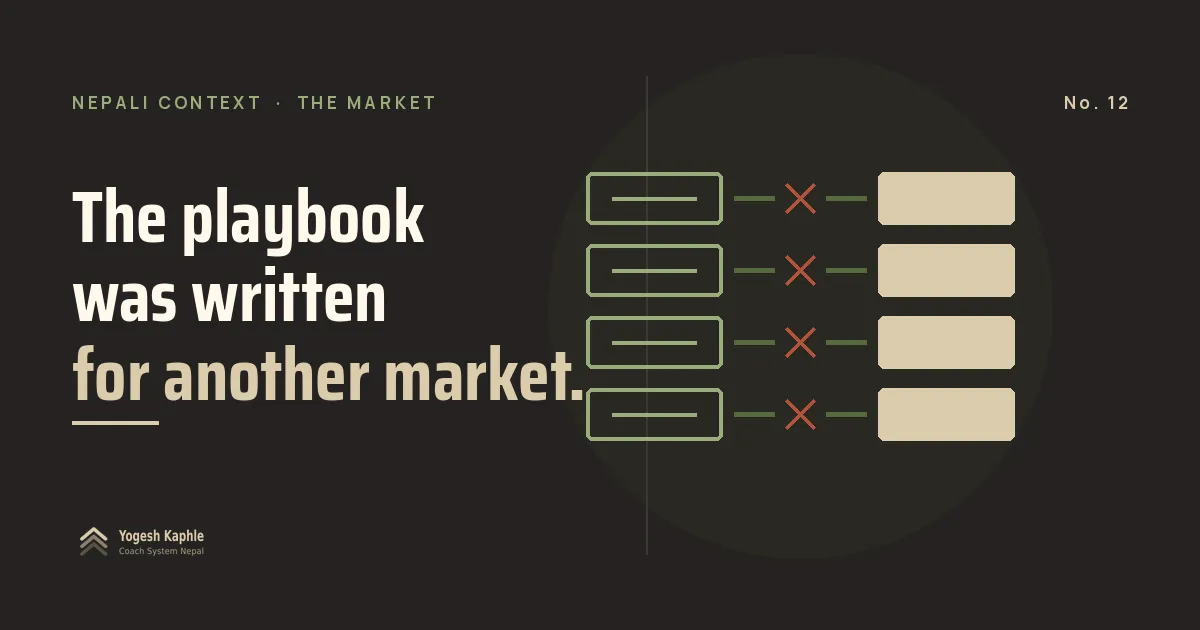
| What the playbook assumes | What is true here |
|---|---|
| The buyer decides alone, on the page | The buyer checks with a known person first |
| Card on file, automatic monthly charge | Wallet, QR, one-time push, decided each time |
| Instagram plus an email list | Facebook, Viber, TikTok, and a phone call |
| ”Too expensive” is a value objection | ”Mahango bhayo” is often a doubt objection |
Four mismatches. Take them one at a time.
Mismatch one: trust travels through a person first
Trust travels through a person.
Before someone pays you, they want to know one thing that no page can answer. Ke yo manche chinne ho? Someone known, or someone who knows someone known. Afno manche bhaye pugcha. That single question sits in front of the sale, and it is not suspicion. It is a rational response to a market where the public trust infrastructure a foreign playbook depends on is thin. Few verified public reviews. No dominant ratings platform for coaching. Refund and dispute mechanisms most buyers have never used and would not count on.
Tesaile the sentence “ekchoti bhetera kura garaun” is not the buyer stalling. It is the buyer trying to complete the trust check the playbook told you to skip.
The imported funnel compresses stranger to buyer into about seventy two hours. In Nepal, that same distance usually gets covered through a conversation, an introduction, or somebody vouching in a group chat. Your funnel is not broken. It is timed for a distance that does not exist here.
That was the contractor on the phone. He was not buying a machine that day. He was checking whether the person selling it knew his site.
Mismatch two: half your market is not on social media
The playbook says Instagram plus email. Your market is somewhere else.
Start with the size of the room. Nepal had 16.6 million internet users at the end of 2025, about 56 percent of the population, and 14.8 million social media identities, roughly 50 percent. Half the country is not on any social platform at all. A playbook written for a near-saturated market treats social reach as the whole market. Here it is half of one, and the half you can reach is spread across Facebook, Viber groups, TikTok and a phone that still rings.
Email is the sharper example. The imported playbook treats the email list as the asset you own. For a mostly Nepal-based coaching audience, most of that list will never open anything. The same person will answer a Viber message in four minutes.
None of that makes Instagram useless. I have written about getting coaching clients from Instagram and the mechanics hold. Tara the mechanics assume the buyer lives there. If yours is a Kathmandu gym owner or a contractor in Butwal, part of your audience does, and part of your audience is in a Viber group you have never seen.
Kinabhane this is a channel-fit problem and not an effort problem, working harder on the wrong platform produces exactly what it looks like: a follower count with nothing under it. That gap has its own post.
Mismatch three: nobody here has a card on file
The playbook’s pricing model quietly assumes a payment rail Nepal does not run on.
“Ninety seven dollars a month, cancel anytime” is not a price. It is a mechanism, and it depends on a card sitting on file that gets charged automatically while nobody thinks about it. That is what makes the subscription model work there.
Nepal’s rails grew a different shape. Nepal Rastra Bank’s own oversight reporting shows wallet users rising from 6.27 million in mid-August 2020 to 23.46 million in mid-July 2024, with connectIPS users going from 0.16 million to 1.28 million over the same period. Enormous adoption. Almost all of it push-based. The buyer opens an app and decides, every single time.
Sit with what that means. Every renewal is a fresh decision. There is no quiet auto-charge carrying you through the month your client felt unmotivated. A model that works on autopilot elsewhere becomes an active monthly sale here, and nobody warned you, so it reads as clients who do not commit.
They commit fine. The rail just asks them out loud, every month, whether they still want to.
Mismatch four: “mahango bhayo” is not “too expensive”
Same words. Different fear underneath.
In the imported playbook, “too expensive” is a value objection, and the prescribed answer is to build more value or reframe the price. Fine advice, for that market.
Here the sentence is usually carrying something else. Mahango bhayo often means: is this real, has anyone like me done this, and what happens to my money if it is not. It is a doubt objection wearing a price objection’s clothes. Answer it with more value stacking and you have answered a question the buyer never asked, which is why the conversation goes quiet and polite instead of arguing with you.
I have written about the too expensive objection and how it is fear rather than arithmetic. Nepali context sharpens it. Buyers here have watched the online course and quick-money space fill up with people who took money and vanished. That memory shows up in your sales conversation whether or not you earned it.
What this does not mean
Three wrong conclusions live near this argument. All three are expensive.
It does not mean Nepal is behind. Behind implies one road with everyone on it at different distances. Nepal built a different payment stack and a different trust stack. A market is not a delayed copy of another market.
It does not mean wait until things mature. The mismatch is not going to resolve itself on a schedule you can plan around. The coaches winning here now are not waiting, and most of them are not doing this full time either. I built mine in the hours around rotating shift work.
It does not mean copy India instead. Closer, and still not yours. Different scale, different ad economics, different language mix, different payment habits.
Borrowing was never laziness. The playbook was in English, it was free, it was everywhere, and for years no one had written the local version. Tesaile the gap is translation. It was never talent.
Nepali coaches reading this: which of the four hit hardest for you? Tell me in the comments which one you have been fighting without naming it.



Leave a comment
Thanks. I read every one. It'll appear once I've seen it.