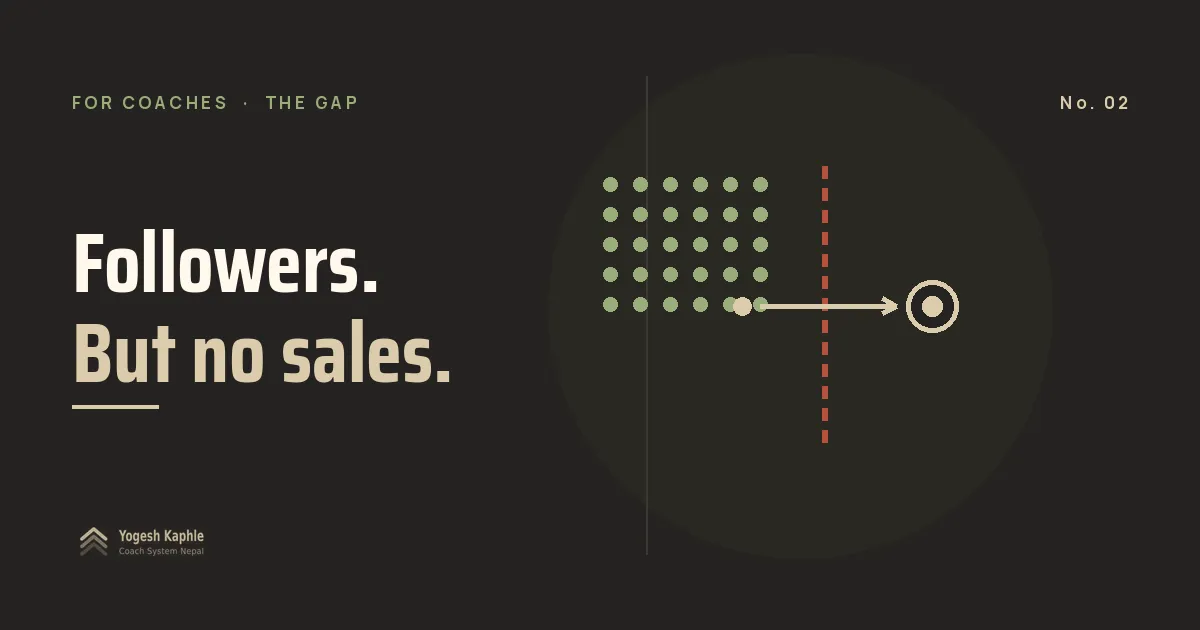
You have been posting for months.
Reels. Carousels. Transformation photos. The one video where you finally showed your face and your voice shook a little. The numbers are not terrible. A few hundred views. A handful of likes. Every so often, a “great content bhai” in the comments.
Your bank balance looks exactly like it did six months ago.
I hear this from coaches every week. Views up, income flat. And almost every one of them thinks their content is the problem.
It usually is not.
Why do you have followers but no sales?
You have followers but no sales because you made the ask in the wrong place, at the wrong time. Not because your content is weak.
Between a stranger scrolling past you and a person paying you, three things must happen. In this exact order.
Attention. They stop and notice you exist. Likes and views measure this. It is the easy part, and the cheap part. People hand out attention all day without thinking. Pew Research Center found that about four in ten social media users say influencers affect their purchases at least a little, but only 3% say those accounts have a lot of impact on what they buy.
Trust. They start believing you actually know your work. That you are not one more person with a phone and a protein shake. Trust is slow. It is built by showing up, again and again, with something useful.
Transaction. They message you and pay. This is the hard part, and it only happens once the first two are done.
Most coaches collapse all three into one post. Content goes up, offer goes in the caption, silence follows. So they post harder. More volume, more frequency, more effort, same result.
They were never posting too little. They were asking strangers to buy.
Why you cannot close on the street
Social media is a street. Your DMs, your WhatsApp, your landing page, that is your office. Meet people on the street. Close them in the office. Never try to close on the street.
Picture it. Someone walks up to you in Ason, someone you have never seen, no introduction, and says “buy this from me, twenty thousand rupees.”
You walk away. Faster if they keep talking.
That is exactly what your “DM me to join my program” post does to someone seeing you for the first time. They do not know you. You have not earned the right to ask. So they scroll. And the platform notices nobody engages with your posts, and shows the next one to even fewer people.
Now run it again with a different person. They have watched your content for two months. They learned something from you that actually worked. They saw you answer questions in the comments with nothing to gain. When you say “I am taking three new clients this month,” they do not walk away. They reach out.
Same offer. Same words. Different stage.
The pitch did not change. The trust did. That geography, street to office, is step 2 of the 5-step system I use to get coaching clients online, and skipping the walk between them is the most common leak I see.
Why one pitch is never enough
Most coaches pitch once, hear nothing, and disappear. The sale was sitting in the follow-up they never sent.
Turning attention into income runs on repetition, not one perfect pitch: it takes an average of eight touchpoints just to earn a first meeting (the full breakdown of that number is here).
Now count your own follow-ups. Most coaches send one. Post the offer, wait, get nothing, decide the audience is cheap and move on.
The audience is not cheap. They are just not ready on the day you happened to ask.
Someone can genuinely want what you sell and still not buy this month. There is a wedding. A cousin’s surgery. Dashain is coming and the money is spoken for. Their job feels shaky. Interested and ready are two different things, and the gap between them is measured in months.
Staying in front of that person is not nagging. It is showing up on a rhythm with something small and useful, so that when the money and the timing finally line up, you are the coach they think of. That is a whole step of its own in the system, and it is the one almost nobody runs.
What does trust actually look like?
Trust is a pattern, not a tactic. It is the same face, the same voice, the same way of thinking, seen enough times that someone thinks: if I work with anyone on this, it is this person.
You build it three ways.
Teach what others charge for. Do not hold back your best material. Coaches fear that giving too much away means nobody pays. The opposite happens. When someone learns something real from you for free, their next thought is: if the free version is this good, what is the paid one like?
Show real results, not vague claims. “I help people get fit” means nothing. “Three of my clients lost over five kilos last month, and here is exactly what changed in their training” means something. Specific is believable. Believable is trusted.
Be there when nobody is watching. Reply to comments. Answer the DM that will clearly never become a sale. Post the week your last one flopped. Trust is built in the boring weeks, not the viral ones.
This work is slow. It does not feel like progress. It gives you none of the dopamine a viral reel gives you.
It is also the only thing that turns a viewer into a buyer.
Where this hits coaches hardest
Everything above is true for anyone selling online. Fitness coaching gets a harder version of it.
You are selling a transformation. Someone hands over their body, their food, their routine, their mornings. They cannot return it if it disappoints them. They are not buying a product. They are buying a relationship with you.
Nobody gives that kind of trust to one reel.
Most fitness coaches I see are stuck at stage one and doing it well. Workout clips. Before-and-afters. Motivation quotes over gym footage. The attention arrives. Then nothing.
The reason: stage two was never built. They never showed the thinking behind the programming. Never explained why most diets collapse in week three. Never told the story of the client who tried everything, finally got results, and exactly what changed.
Without that, you are one more fit person on the internet. People watch you the way they watch anything else. Then they scroll on.
The mistake everyone makes
When posts do not convert, most coaches make more posts.
Wrong move.
If your content is not building trust, doubling the volume just means twice as many strangers ignoring you. Volume does not fix timing.
Ask yourself something uncomfortable. When someone watches three of my videos back to back, do they trust me more than before they started? Or did they get entertained for nine minutes and forget my name?
If it is the second one, that is not a reach problem or an algorithm problem or a camera problem.
Stop trying to go viral. Start trying to be useful. One viewer who learns a real thing from you is worth a hundred who liked a post and forgot it. And when they are ready, you need a way to reach them, which is why getting their contact off Instagram is the next thing to fix.
Which stage are you actually stuck on: attention, trust, or the ask? Drop it in the comments. I read every one.
Leave a comment
Thanks. I read every one. It'll appear once I've seen it.