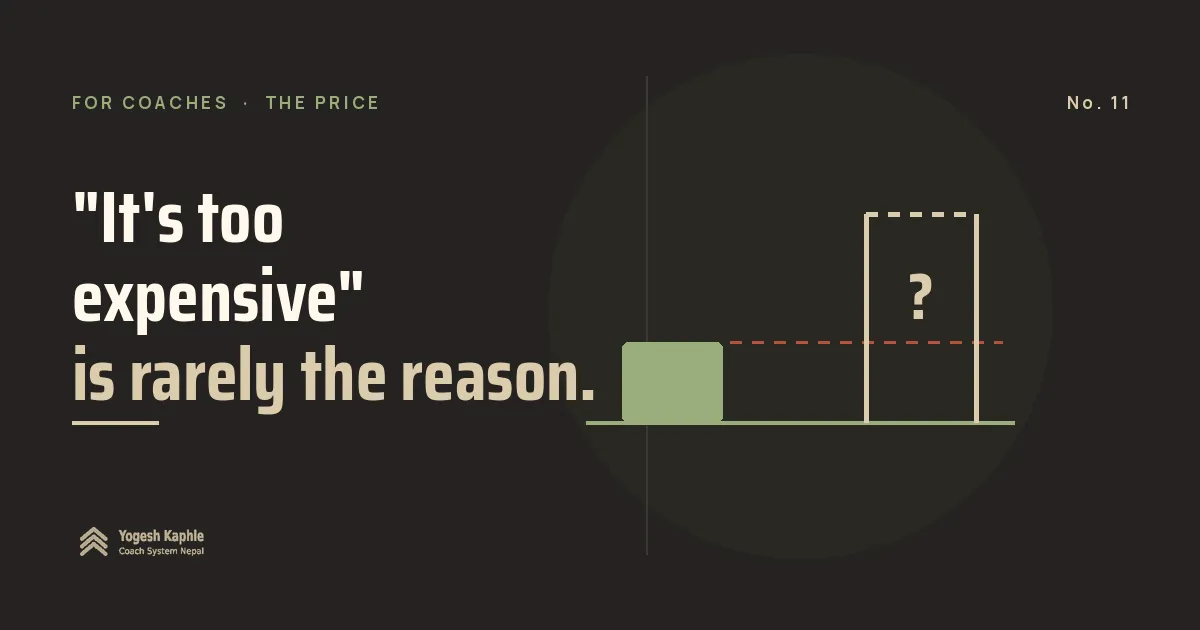
The year I said it was too expensive and walked away
- No job. A fitness coaching certification batch open in front of me, and more free time than I have had before or since.
First thought: too expensive.
Then came the reasons. Better to wait for the next batch. Better to sort out income first. Better to do it when I could give it proper attention, as though attention was the thing I was short of.
I skipped it.
I enrolled a year later, in 2025. Day one, sitting there, I did the arithmetic I should have done twelve months earlier. The money had been arrangeable the whole time. Borrowed, saved, cut from somewhere. Findable. What stopped me was not the fee. It was that I could not tell you whether the thing was worth it, and “too expensive” was the only way I had of saying that out loud.
Twelve months. That was the real invoice.
What does “coaching is too expensive” actually mean?
It means the comparison stopped halfway.
Your prospect priced your program. They never priced the year without it. Two different numbers, and only one of them got calculated.
Underneath the sentence, three things are usually hiding.
| What they say | What they are actually pricing |
|---|---|
| ”It’s too expensive" | "I don’t believe this will work for me" |
| "I need to think about it" | "I don’t trust myself to finish it" |
| "Maybe next month" | "I don’t know what this is worth” |
Mine was the third one. I had the time. I had the empty calendar. And I still could not put a value on the certification, so I priced it against zero.
Against zero, everything is expensive.
Price gets compared to risk, not to money
Drazen Prelec and George Loewenstein published a paper in 1998 called The Red and the Black. Their finding, stripped down: paying hurts on its own. Not because of what you give up later. Because of the act of handing the money over.
They called it the pain of paying, and their example is a taxi meter. Same ride either way. Watching the number climb makes it worse.
What that means for you: the flinch your prospect has when you say your price is not a calculation. It arrives before the calculation. They feel the cost first, then go looking for a reason to explain the feeling.
“Too expensive” is the reason they find.
So when you defend your price, you are arguing with the reason. Not the flinch.
In Nepal the objection wears a different costume
Here, nobody says no.
“Arko mahina.” “Sochera bhanchu.” “Gharma sodhera bhanchu.” A straight no is rude, so the price becomes the polite exit. It hands both people a way out where nobody loses face.
Mine was arko batch. Next batch. It sounded like planning.
It was fear with a calendar.
If you coach in Kathmandu, or Pokhara, or over WhatsApp with clients you have never met in person, you will hear this constantly and you will misread it constantly. “Arko mahina” is not a maybe. It is a no with manners on. Treat it as a maybe and you will spend six months chasing a lead who decided in the first ten minutes.
Price is only one of the places the imported playbook misreads this market. It gets the trust timeline, the platform mix and the payment rails wrong in the same way, which is what I unpack in why the foreign playbook fails for coaching clients in Nepal.
The objection was set before you said a number
By the time price comes up, most of the decision has already happened.
Two things usually did the deciding.
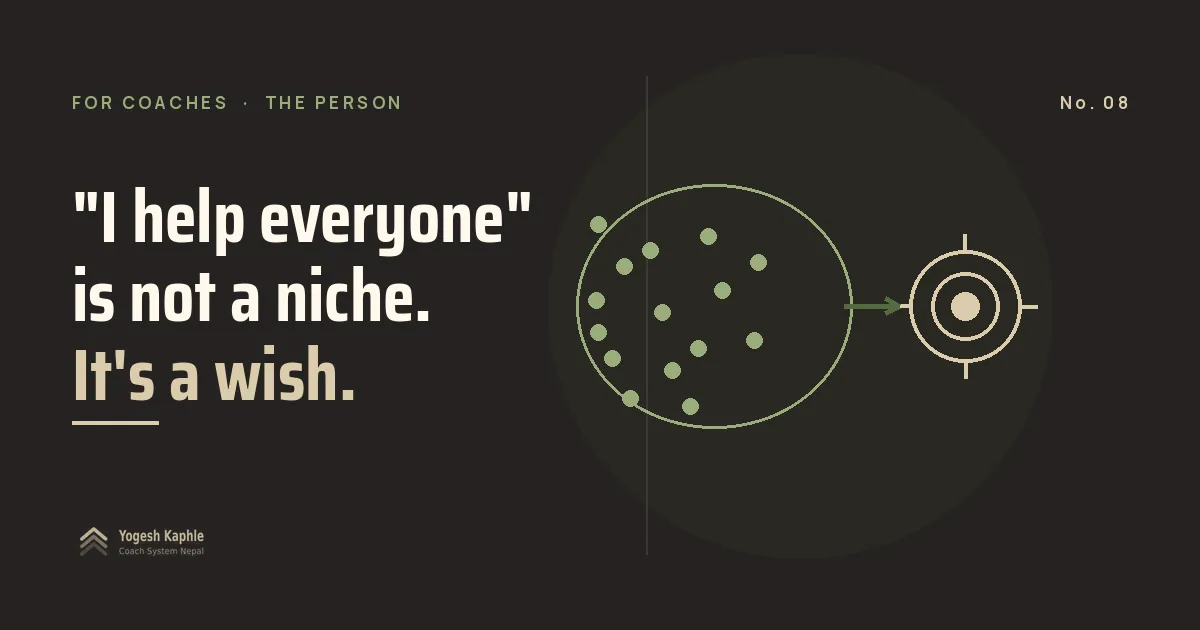
The first is who you were talking to. If they were never the right person, no number was going to work. That is a Step 1 problem, and it is why niching down as a coach fixes more price objections than any script does. Wrong person, wrong price, every time.
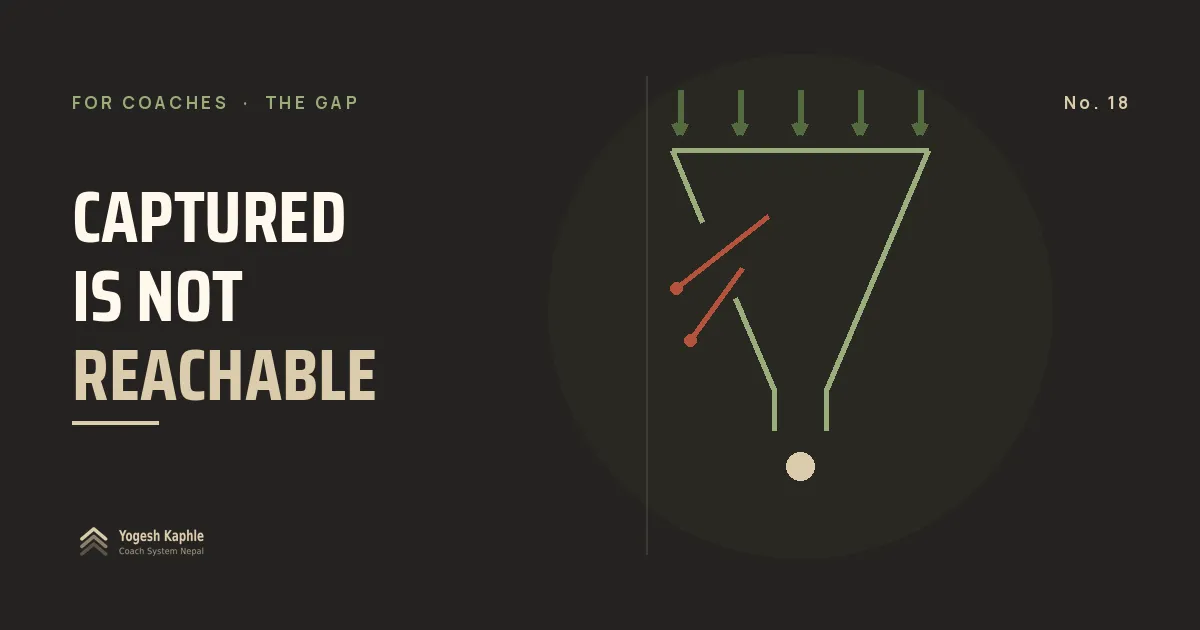
The second is how many times they had heard from you before the number came out. One message, silence, then a price. Of course it feels expensive. They do not know you well enough for it to feel like anything else. That is Step 3, and it is the exact place most coaches quit: following up with leads.
There is a third thing, and it sits on your side of the table. If asking for money makes you feel like a fraud, your prospect hears it in your voice before they hear the figure. I wrote about that one separately, in selling feels pushy. That post is about your fear of asking. This one is about decoding theirs. Not the same problem, and the fixes do not swap.
What changes when you stop defending the price
You stop selling the program and start pricing the alternative.
Most coaches hear “too expensive” and do one of two things. Drop the price. Or list features until something lands. Both are arguments about your offer. Neither one touches the comparison actually running in your prospect’s head.
The move is to change what your price gets measured against.
Right now it is measured against zero. Against doing nothing, which is free. Nothing wins that fight every single time.
Except doing nothing is not free. It carries a price, your prospect has been paying it for months, and not one person has ever asked them to add it up. Six more months of guessing. Another year of posting content that goes nowhere. The clients they will not sign, because they still do not have a system to sign them with.
That is the number that competes with yours.
I am not handing you a script for this. The sequence, the timing, the exact questions, when to stop talking, that is the system I build with coaches, and it does not fit in a blog post. What you can take today is the reframe. Stop defending. Start comparing.
So: what is the last objection that stopped you cold, and what do you think was hiding behind it? Drop it in the comments. I read them.
Leave a comment
Thanks. I read every one. It'll appear once I've seen it.