A machine that costs 45 lakh does not sell itself.
Most coaches treat coaching client referrals like weather. Something that arrives if you are lucky and deserving. I watched them get manufactured on purpose, at a price point no coach will ever charge.
I know, because I led the team that sold them. Ninety-plus units. Every one of them started as a conversation, not a click. No advert closed a deal. No brochure closed a deal. Someone picked up the phone, then got in a jeep, then sat in a dusty site office in the Terai and talked to a man who had already decided whether he trusted me or not.
The first sale in a new district took weeks. Sometimes a month.
Then the buyer ran the machine. It did what I said it would do. And he mentioned my name to two other men in the same trade.
Those two closed in days.
Same product. Same price. Same pitch. A fraction of the work.
Now the coach. Six months of training, a real transformation, a client who cries on the last call. Then a thank-you message. Then Monday, and back to sending cold messages to strangers on Instagram.
The machinery loop was available the whole time. Nobody used it.
Coaching client referrals start where the sale ends
Ask a coach what happens after a client pays and you get a version of the same answer. “I send them the plan.” “I add them to the WhatsApp group.” “I set up the first call.”
That is a handover, not a system.
The machinery deal had an ugly version of this too. Sell the unit, collect payment, walk away. The ones who worked that way sold one machine per district and wondered why. The buyer got the thing and then sat there not knowing how to run it properly, blaming the machine, telling other people the machine was a problem.
Coaching does the same thing quieter. The client gets the plan. They do it slightly wrong. They get a slightly worse result. They do not complain. They just do not come back, and they do not send anyone.
Why do clients quit when they are getting results?
Not week one. Week one they are fired up. New plan, new coach, new person in the mirror. Week one runs on excitement and excitement is free.
Week three is where it goes.
By week three the newness has worn off. The scale has not moved much. Work is busy, there is a family event, the gym is a 25-minute walk in Kathmandu traffic. And the result, the real one, is still eight weeks away.
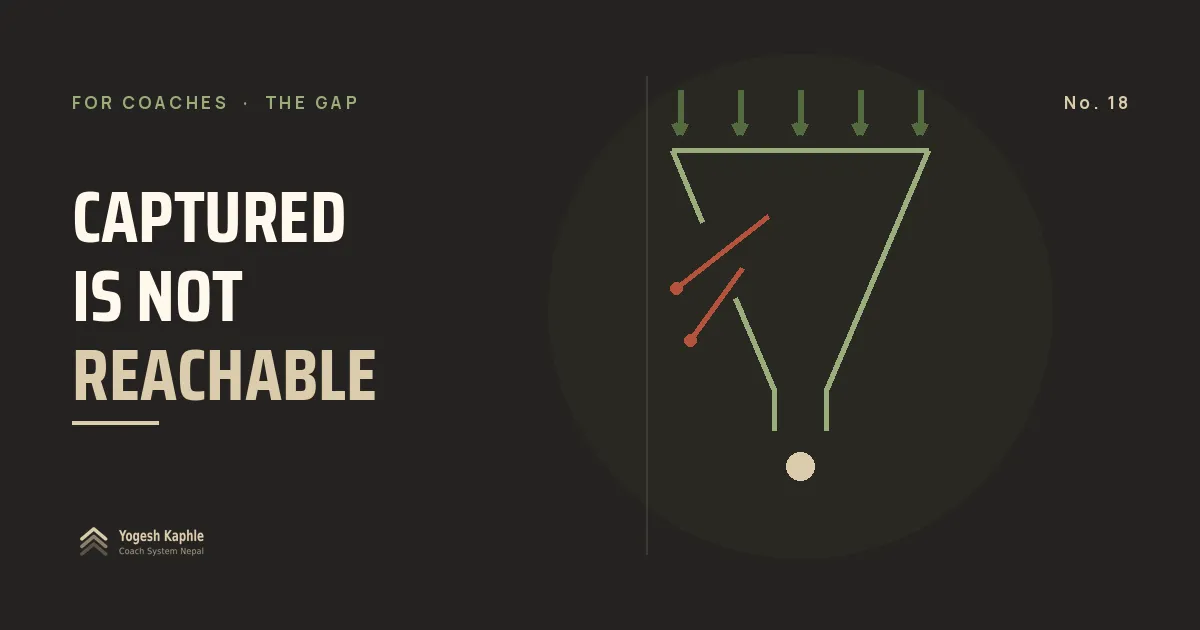
That gap between effort spent and result visible is where you lose people. Not because your programme is bad. Because nothing in it was built to carry them across an empty stretch.
If you coach fitness, that gap has a physical cause and a fixable shape, and I took it apart properly in the week three wall.
The fix is boring and it works: engineer a small win they can feel in the first 48 hours. One task completed. One number logged. One thing they could not do on Monday and can do on Wednesday. It does not need to be impressive. It needs to be theirs.
A client who has already won once will keep going to win again. A client who has never won anything yet is only running on your enthusiasm, and yours runs out too.
What a client actually pays to stay for
Most solo coaches are selling one thing and calling it three. Correction. Feedback. Their attention. All the same thing.
There are three parts to keeping someone winning, and coaching is only one of them.
| The part | What it is | What happens when it is missing |
|---|---|---|
| Curriculum | The path, written down, so the client knows what comes next without asking | They depend on you for direction, so every question routes to your phone |
| Community | Other people walking the same road at the same time | They quit alone and quietly, and you find out three weeks later |
| Coaching | Correction at the moment it matters | They follow the plan wrong, get a poor result, and blame themselves |
Look at your own delivery honestly. Most coaches score one out of three, and it is always the third one.
That is also why so many coaches are drowning. If coaching is your only mechanism, then every single client outcome runs through your available hours. There is no version of that which scales, and no version of it that survives a full-time job.
Keeping clients without drowning in them
I build this business in the gaps around shift work. Thirty hours a week on a good week, less on a bad one. So retention that depends on me being reachable is not a strategy, it is a countdown.
Retention that survives a real life looks like this: a written path, a rhythm the client can follow without you, and one proper review a month where you sit with their numbers and tell them the truth.
Not daily check-ins. Not being on WhatsApp at 11pm because someone wants to know if roti is allowed.
And if a client genuinely needs you every day, that is information. The programme is not clear enough, or the win is not visible enough, or you sold them something they were not ready to run. Fix the thing, not your sleep schedule.
Async beats live more often than coaches expect. A short recorded update, sent when you have the energy to make it good, lands better than a live call squeezed into a tired evening.
One winning client is three assets
Here is the arithmetic that made the machinery business work, and the arithmetic almost no coach runs.
A client who wins gives you three things:
- Proof. A before and after, a number, a screenshot. This feeds everything you post. Content without proof is opinion, and there is a lot of free opinion already.
- A story. Not a testimonial saying you are lovely. A story with a starting point, a specific obstacle, and a number at the end. This is what you bring to a sales conversation when a stranger says they are not sure it will work for them.
- An introduction. The warmest lead you will ever get, arriving pre-trusted.
The research backs the third one hard. In a study tracking roughly 10,000 bank customers over almost three years, referred customers turned out to have a higher contribution margin, a higher retention rate that persisted over time, and a lifetime value at least 16% above comparable customers acquired through other channels. Cheaper to get, and they stay longer once they arrive.
Coaching client referrals are the cheapest lead you will ever get. Cold outreach is the most expensive. A coach with no delivery system picks the expensive one, every month, on purpose.
If you have read why coaches quit after one message, this is the same discipline pointed somewhere better. Following up with a stranger takes seven touches. Following up with someone whose friend already vouched for you takes one.
Why “let me know if you know anyone” gets you nothing
That sentence feels polite. It is also the reason nobody refers you.
Look at what it asks a busy person to do. Search their memory for someone with a problem. Judge whether that person is ready. Decide whether recommending you is safe for their own reputation. Then start a conversation they did not plan to have.
Four jobs. You handed all four to someone who was just trying to say thank you.
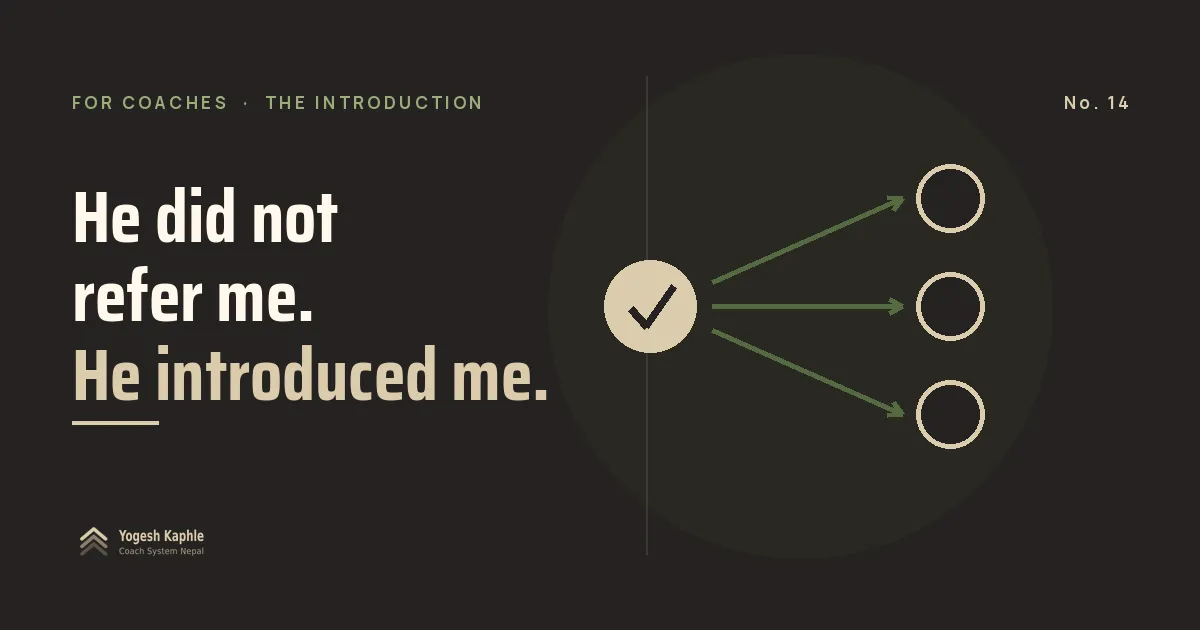
The machinery buyer never did any of that. He did not refer me. He introduced me. He rang a man he knew, said my name, said what the machine had done on his site, and put us in the same room. His credibility went in first. My pitch came second.
The difference is who does the work.
So make it one job instead of four. Name the person. “You mentioned your cousin runs a studio in Lalitpur and is stuck at the same place you were in March. Would you put the two of us in one message together?”
Specific person. Specific reason. One action for them. And you ask it in the week the result lands, while they can still feel it, not six months later when the win has faded into normal life.
Running a business around a job means the maths of your time matters more, not less. I wrote about that trade-off in why I did not quit my job to build this.
So: which of the three parts is missing from your delivery right now, curriculum or community? Tell me in the comments. I read them all.
Leave a comment
Thanks. I read every one. It'll appear once I've seen it.