Walk into any gym in Kathmandu in the first week of Baisakh.
Full. Every bench taken, a queue for the squat rack, new shoes everywhere. New year, new plan, new person.
Now go back in Jestha.
Half of them are gone. Same gym, same equipment, same trainers. The crowd just evaporated, and it evaporates on roughly the same schedule every single year.
That emptying is the whole of fitness client retention, compressed into six weeks and visible from the door.
Most coaches read that as a discipline story. Nepali people don’t stick to things. Clients these days have no patience.
A thing that happens on a schedule is not a character flaw. It’s a system doing exactly what it was built to do.
Fitness client retention is not a motivation problem
Motivation is real. It’s also the least reliable material you could possibly build with, and every coach knows this about themselves and forgets it about their clients.
Week one runs on novelty. New routine, new coach, new mirror. That fuel is free and it burns fast.
By week three it’s gone. Nothing has replaced it. And the client, who has never done this before, reads an empty tank as evidence that they are the problem.
They aren’t. Your program is running on a fuel source you never topped up.
What is actually happening to your client in week three
One concept, explained plainly.
When an untrained person starts lifting, they get stronger quickly. Within two weeks they’re moving more weight and it feels great. But most of that early jump isn’t new muscle. It’s the nervous system getting better at the job: recruiting more motor units, firing them in better order, coordinating the movement. The muscle hasn’t changed much yet. The wiring has. This is well established in the research on early strength gains, and visible muscle growth generally trails it by a month or more.
So follow the timeline your client is actually living.
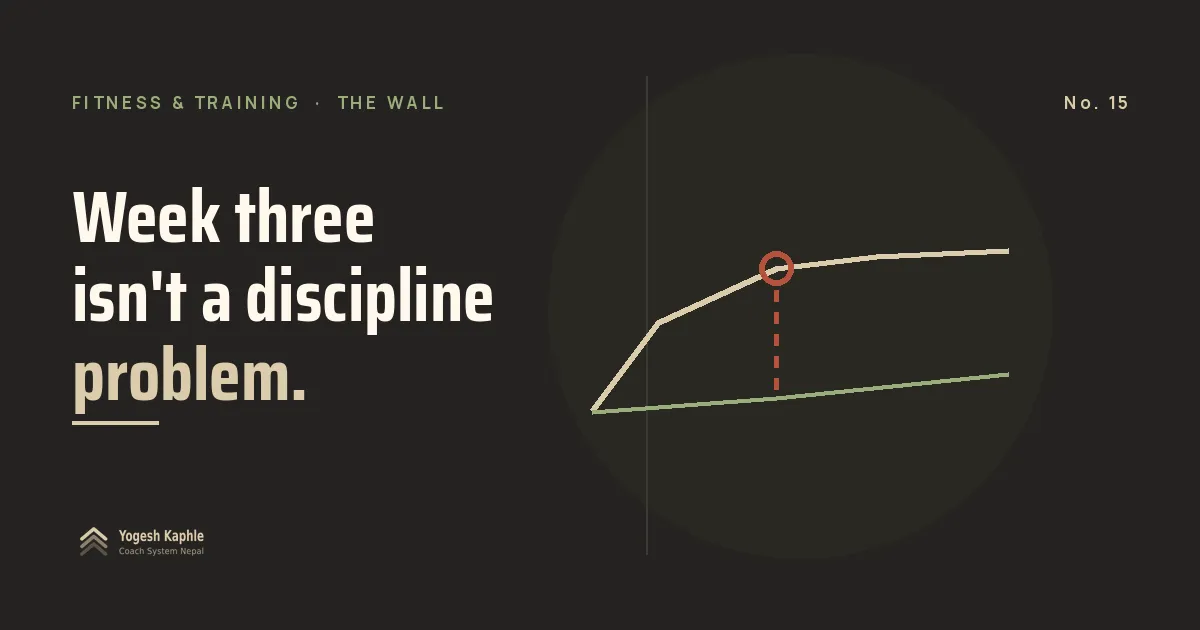
Week one, everything is new. Week two, the weight goes up and they feel powerful. Week three, that first jump flattens out, because the easy wiring gains have been banked. And the body in the mirror still looks like it did in Baisakh.
They call it “it stopped working.”
It didn’t stop. They walked into the flat part, and nobody told them the flat part existed.
Give them a scoreboard their body can’t yet give them
The body is a slow scoreboard. Eight weeks, twelve, sometimes longer before a person looks in the mirror and sees the difference themselves.
You cannot speed that up. You can run a faster scoreboard next to it.
Things that visibly move inside three weeks:
- Load on one lift they actually care about
- Reps at the same load
- A movement they could not do in week one and can do now
- Sessions completed, in a place they can see
Notice what’s missing from that list. Weight on the scale. It’s the number every client fixates on and the one least likely to reward them in three weeks. If the scale is your only metric, you have handed your retention to the slowest, noisiest number available.
Pick something that moves. Then make sure they see it move.
Are you programming for week three, or hoping through it?
Open your current template and find week three.
Most templates don’t have one. They have a structure that repeats, a progression that ticks along, and an unspoken assumption that the client’s enthusiasm holds steady throughout. It doesn’t, and you knew that already.
Week three needs building on purpose. A deliberate small progression they will feel. A session they enjoy rather than endure. A check-in that reads as interest, not surveillance.
And the honest part nobody says out loud: your attention drops in week three too. The new client stops being new. You stop watching as closely. The novelty was mutual, and it ran out on both sides at the same time.
What one quit client actually costs you
The fee is the smallest of it.
| What you lose | Why it hurts more than the money |
|---|---|
| The month’s payment | You budgeted for it, and it’s the only loss you’ll actually notice |
| The proof | The eight-week transformation you needed for content. Gone at week three, before it existed |
| The introduction | The people they would have brought once it visibly worked |
Coaches pre-proof feel this hardest. You need results to show, results take eight to twelve weeks, and a client who leaves in week three takes your evidence with them. I went through the arithmetic of that in what a winning client is actually worth.
Without that proof you end up filling the gap with free work instead, which is the trap I spent six months in and wrote up in 20 videos, 550 subscribers, zero rupees.
The weekly check that takes four minutes
Retention does not require you to be reachable all day. If you’re building a coaching business around a job or a shift pattern, it can’t.
Four minutes per client per week, same slot:
- Look at their number. The one you picked on day one.
- Look at sessions completed.
- Send one message that names something specific they did. Not “keep going.” Something they’d recognise as evidence you were paying attention.
That’s it. The point isn’t the four minutes. The point is that it happens in week three whether or not you feel like it, because it’s in the calendar and not in your mood.
Your move
Open your program template right now and write one line into week three: the specific win the client should be able to point at by the end of it.
One line. One win. That is fitness client retention in its entirety, and it costs you nothing but the ten seconds it takes to write it down.
What week do your clients usually go quiet on? Tell me in the comments, I want to know if week three holds up outside my own reading of it.


Leave a comment
Thanks. I read every one. It'll appear once I've seen it.