The youngest man in the room
The company was British. Maritime security, anti piracy escort. Four and a half years of it.
Almost everyone on that contract had come out of the army after fifteen years. Grey at the temples. Stories from places I had only heard about. I had joined the army at eighteen and left. I was twenty four.
Then one day I was told I would lead the Nepali team on an escort.
Not assist. Lead.
That meant meeting the captain. Briefing his crew. Sitting down with him to work through the ship security assessment and the anti piracy plan, section by section, and getting him to sign off on it. Running the weapons drill with my own team. Taking them through the transit. Bringing back the report.
I remember thinking that this was a lot. Not in a dramatic way. Just a quiet, factual thought: this is more than I have ever carried.
Nobody in that room stopped to ask how I felt about it.
The gap nobody warned us about
Everyone on the team thought they knew English. Every one of us had studied it, used it, tested in it.
Then the British team leader opened his mouth.
The words were English. The tone was something else entirely. Speed, accent, the swallowed half of every sentence. On a live drill, with weapons in hand, “say again” is not a comfortable phrase to keep repeating.
I caught up faster than the others. Not because my English was better. Because I stopped trying to translate the words and started listening to the shape of how he spoke. That is the only reason I ended up leading. Not seniority. Not years. I closed a gap that everyone else was still pretending was not there.
That is a whole other story, and I will write it properly one day.
How do you know when you are ready?
You do not. That is the answer.
Readiness is not something that arrives and taps you on the shoulder. It gets manufactured after the fact, by the situation itself, once the situation refuses to let you off.
Every chapter of mine has taught me the same lesson. Army at eighteen with no real plan. The sea at twenty four. Four years leading sales teams back in Nepal. Shifts in Macau now, building this in the hours around the job instead of waiting for a clean runway that is never going to arrive.
You make the situation work, even when it is not in your favour.
Look at how this works in practice.
| What you are waiting for | What actually happens |
|---|---|
| To feel qualified, then start | You start, then feel qualified |
| To have the perfect offer, then sell | You sell, and the offer sharpens on real objections |
| To be an expert, then teach | You teach, and get exposed to what you do not know |
| To feel confident, then act | You act badly, then less badly, then confidently |
The order is reversed from the one in your head. Every time.
Why coaches get stuck here
Talk to enough coaches in Kathmandu and you will hear the same sentence in different clothes.
“I will start posting once I have my content properly planned.”
“I will take online clients once I finish this next certification.”
“I will charge properly once I have more results to show.”
It sounds like patience. It sounds like doing things the right way, in the right order, not rushing.
It is not. It is fear wearing a respectable outfit. I have written about how the same thing shows up at the moment of the ask, in selling feels pushy. Same fear, different room.
Your buyers do it too. When someone tells you that coaching is too expensive, they are usually buying time the same way I was, just from the other side of the table.
The people who feel most unready are usually the ones already carrying enough to do the job. The genuinely unprepared rarely worry about it. That is the cruel arithmetic of it. Psychologists named this in 1978. They called it the impostor phenomenon, and they found that achievements which should prove you belong somehow never do.
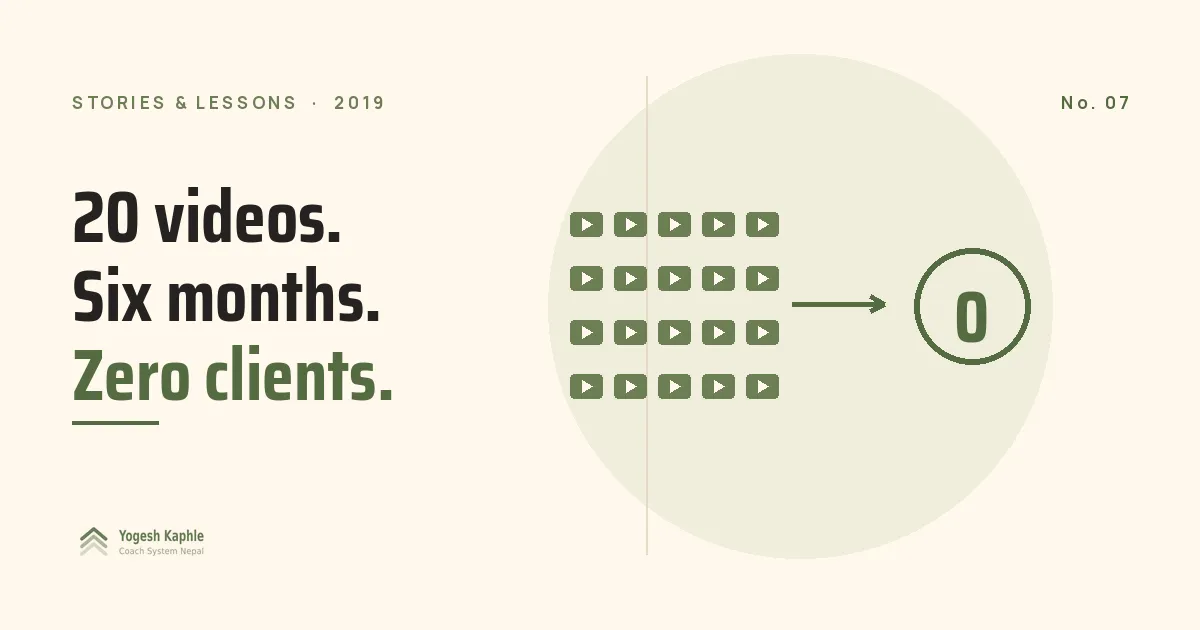
I sat on a YouTube channel for six months in 2019, made twenty videos, got zero clients, and told myself I needed to learn more first. I did not need to learn more. I needed a system. That story is here, and it is the same disease as this one.
The bridge to what I do now
People ask why I coach coaches when I am not sitting on a decade of agency wins.
This is why.
I have been handed responsibility before I felt entitled to it, repeatedly, and built the competence under live load every single time. On a ship. In a sales floor in Nepal. Now on a laptop between shifts in Macau.
That is exactly the position a coach is in when they decide to build a real business instead of a busy Instagram account. They are being asked to run something they have never run. They do not feel ready. They are not going to feel ready.
What they need is not more readiness. It is a structure that holds while they get good.
I know what that feels like from the inside. That is the whole qualification.
Twenty four years old, briefing a ship’s captain, absolutely certain I was the wrong man for it.
What are you postponing until you feel ready? Tell me in the comments. I will answer every one.

Leave a comment
Thanks. I read every one. It'll appear once I've seen it.