

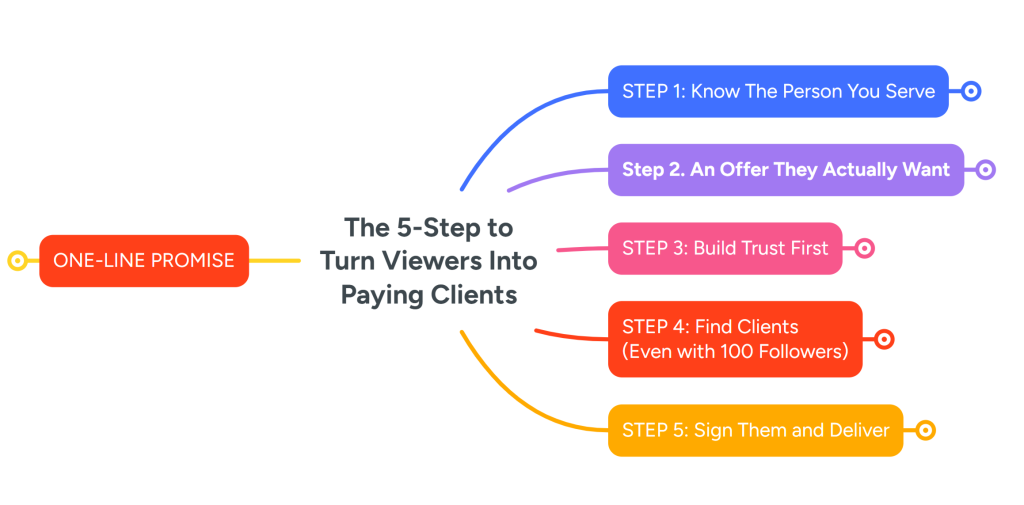
Most fitness coaches in Nepal stay stuck because they treat posting as a business strategy. It isn’t. The coaches who consistently sign clients run a 5-step system: pick a specific audience, build a clear offer, create trust through proof, capture leads with a landing page, and then deliver inside a system that scales. This is that system, broken down for coaches with under 1,000 followers.
For fitness coaches who are posting consistently but still waiting for their first – or next – paying client.
The Real Problem Nobody Talks About
You’re posting. You’re showing up. Workout videos, nutrition tips, transformation photos.
And still no paying clients.
You get likes. Sometimes comments. Occasionally someone says “great content bhai!” Then they disappear.
Here’s the hard truth: posting is not a business strategy. It’s just posting.
The coaches who consistently sign clients aren’t necessarily posting more than you. They’re operating with a system. A clear, repeatable system that takes a stranger from “who is this?” to “where do I pay?”
This is that system.
Step 1: Know Exactly Who You Serve
Most coaches skip this step because it feels too simple. It’s not.
“I help people get fit” is not a target. It’s a wish.
The more specific you are about who you serve, the more that person feels like you’re speaking directly to them. And when someone feels truly seen, they trust you faster, engage more, and buy sooner.
Ask yourself three questions.
Who are they? Not just “fitness enthusiasts.” Get specific. Are they a busy professional sitting 8 hours a day in Kathmandu? A parent who wants energy to keep up with their kids? A gym trainer who wants to move their coaching online?
What do they actually want? Not the surface answer. The real one. Not “lose weight” but “lose the belly without giving up momo and chiya.” Not “get more clients” but “get paying clients online without needing 10,000 followers.”
What is blocking them? Time? Money? Past failures? Confusion about where to start? “I tried posting for 6 months and got zero clients.” “I don’t know how to explain what I do online.” “People say they’re interested then go quiet.”
How Do You Pick the Right Audience When You’re Just Starting Out?
The Old Me Strategy
Here’s the real problem most coaches face at this stage: they don’t know who to pick.
Targeting everyone feels safe. Cast a wide net, catch more fish. But in practice, talking to everyone means connecting with no one. Your content becomes generic. Your offer becomes vague. And vague doesn’t sell.
So when you’re not sure who your ideal client is, use the simplest shortcut available to you.
Pick the old you.
The version of you before you figured it out. Before the discipline clicked. Before you understood training, nutrition, or how to build consistency. That person already knows their fears. Their excuses. Their failed attempts. Their exact frustration at 11pm when they’re scrolling Instagram wondering why nothing is working.
You don’t need to research that person. You lived as them.
This is especially powerful when you’re starting out. You don’t need a case study. You don’t need ten testimonials. You just need to remember what it felt like to be stuck — and speak to that person directly.
“I help busy professionals in Kathmandu lose weight without giving up the food they love” hits harder than “I help people get fit” because one person wrote it from experience and the other wrote it from hope.
The test: fill this sentence before moving forward.
“I help [specific person] get [specific result] without [specific obstacle].”
If you can’t fill it clearly, everything else in this system will leak. Fix this first.
Step 2: Build an Offer They Actually Want
Most coaches sell a service. The coaches who sign clients sell an outcome.
There is a big difference.
“I offer online coaching” is a service. Nobody wakes up wanting online coaching. They wake up wanting to lose 10kg, have more energy, stop feeling embarrassed at their own gym, or finally build a client base that pays their rent.
A winning offer has four parts.
Clear Result. What specific outcome will they get? Bad: “I’ll help you get fit.” Good: “Lose 10kg in 90 days.” Good: “Get your first 5 paying clients in 60 days.”
Clear Timeline. How long will it take? Uncertainty kills decisions. Give them a container. “In the next 90 days.” “Within 60 days of starting.”
Clear Process. How will you deliver the result? People don’t just buy the destination, they want to know the road. “Weekly check-ins plus a custom plan plus accountability calls.” “Website setup plus content system plus lead generation training.”
Clear Safety Net. What happens if it doesn’t work? This is the part most coaches skip because it makes them nervous. Don’t skip it. A guarantee signals confidence. It removes the risk from the buyer’s side and puts it on yours, which is exactly where it belongs when you believe in what you do. “If you don’t get results, I coach you free until you do.”
The test: write this sentence out loud.
“I will help you [result] in [timeline] through [process], and if it doesn’t work, [guarantee].”
If it feels uncomfortable, that discomfort is telling you something worth fixing.
Step 3: Build Trust Before You Ask for Anything
You have your person. You have your offer. Now nobody knows you exist.
This is where content comes in. Not random content. Purposeful content that builds trust with the exact person you defined in Step 1.
Three ways to build trust.
Content that educates. Share knowledge people would normally pay for. Don’t hold back your best ideas thinking it will reduce your value. The opposite is true. Giving real value for free makes people think: if this is free, imagine what the paid experience is like.
Proof that is real. Client transformations. Testimonials. Case studies. Even your own journey. Specific proof beats vague claims every time. “I lost 5kg in 3 weeks” hits harder than “great coach.” “I got my first client within 3 weeks of starting” hits harder than “results guaranteed.”
Consistent presence. Not daily. Predictably. Showing up weekly with value builds a pattern in people’s minds. They start to think: this person knows what they are doing. Trust is repetition plus proof over time.
This is why timing matters as much as content — the moment you ask for the sale decides whether the sale happens.
The Street vs Office Strategy
Think of social media as the street. People are there to scroll, laugh, get entertained. You have 3 seconds to stop them. You don’t own this space. The algorithm does.
Your website is your private office. No distractions. No competing content. One purpose: build trust, capture leads, make the ask. You own it. It works while you sleep.
Every post on the street should invite people into your office. Not with “BUY NOW.” With something like: “Want the full guide free? Link in bio.”
One post does not convert anyone. Trust is built through repetition. Show up weekly. Give real value. Let proof accumulate.
Step 4: Find Clients Even With 100 Followers
Here’s why most coaches never get clients from their content.
You post. You get views and likes. You wait for DMs. Nothing comes. You post more. Still nothing.
This is not a content problem. It is a system problem. Three things are usually missing.
The Missing Piece
A landing page.
Social media posts disappear in 24 hours – and so do the people who liked them. A landing page stays online forever. One simple page that explains who you help, what results you deliver, how it works, what it costs, and how to get started. It captures name and WhatsApp number in exchange for something free: a guide, a checklist, a short video. It works 24/7. It qualifies leads for you. Serious people click. Browsers scroll past.
Paid ads. Organic reach on a small account is brutal. Your posts reach maybe 5 to 10 percent of your followers on a good day. Paid ads let you skip the algorithm entirely. You put your landing page in front of your exact ideal client: right age, right city, right interests. You can start with as little as $1 a day. Zero followers. Zero wait. First leads in 3 to 7 days.
Two honest paths forward.
Path A: Organic only. Post 3 to 5 times a week. Engage daily. Build community. Use strong CTAs. Timeline: 6 to 12 months before real traction. Reality: most coaches quit before results show.
Path B: Landing page plus paid ads. Build one simple landing page. Offer one free resource. Run a small daily ad. Follow up on WhatsApp within 24 hours. Timeline: first leads in 3 to 7 days. Reality: you control the flow. Spend more, get more leads.
Organic can work. But it is a long game. If you need clients this month, Path B is the faster and more measurable route.
Step 5: Sign Them and Deliver
Getting a lead is not the same as getting a client. And getting a client is not the same as keeping one.
This last step is where most coaches either lose the sale or lose the client after getting them.
The Consultation
Don’t pitch. Diagnose.
Ask questions first. Understand their specific situation. Then explain how your offer solves their problem, not a general problem, their specific one.
Handle objections honestly. “Too expensive” means show them the ROI: what does staying stuck actually cost them? “Not sure yet” means remind them of the guarantee. “Need to think about it” means give a soft deadline: “I have one spot opening this week.”
The Onboarding
The sale is the beginning, not the end.
Send the first task within 24 hours of signing. A small win early builds momentum and confirms you are the real deal. Set clear expectations for Day 1, Week 1, and Month 1 so they always know what is coming next.
The 3 Cs: How to Deliver in a Way That Actually Scales
Most coaches hit a ceiling not because they lack clients but because of how they deliver.
When every client needs you personally for every question, every session, every decision, you are not running a coaching business. You are running an exhausting 1-on-1 operation with no room to grow.
The 3 Cs framework breaks that trap.
Curriculum. Build a step-by-step system that guides your client through the journey without you having to reinvent it each time. Standards, progressions, resources, and milestones that work for any client inside your niche. You build it once. It runs repeatedly.
Community. When clients are surrounded by others on the same journey, something shifts. They motivate each other. They answer each other’s basic questions. They share wins and hold each other accountable. Your role stops being the sole source of energy and becomes the guide at the top of the room.
Coaching. With curriculum doing the heavy lifting and community providing the daily support, your actual coaching becomes what it should be: accountability, personalisation, and course correction. High value. Not high volume.
This is how you go from “I need to be available 24/7” to “I have a system that delivers results whether I am online or not.”
And here is the thing most coaches miss: this structure is actually better for the client. They are not dependent on you showing up every day. They are inside a system built to work.
The Referral Loop
Ask for a testimonial after the first real win. Not before.
Video beats text. Specific beats vague. “I got 3 paying clients in 5 weeks” beats “highly recommend” every single time.
One great client experience, handled well, compounds into five more clients. That is not motivation poster talk. That is just how referrals work.
The One-Line Truth
Know who you serve. Build an offer they want. Show up consistently with proof. Get in front of them with a landing page and ads. Deliver inside a system that scales.
No algorithm hacks. No viral moments required. No 10,000 followers needed.
Just the system, running consistently.
Key Takeaways
- Targeting “everyone” means connecting with no one — pick one specific person, ideally the version of you before you figured it out.
- A winning offer has four parts: clear result, clear timeline, clear process, and a clear safety net or guarantee.
- Trust is built through consistent presence plus real proof — specific results beat vague claims every time.
- Social media gets attention, but a landing page is where serious leads actually convert.
- The 3 Cs framework — curriculum, community, coaching — is what lets a fitness coaching business scale past 5 clients.
Are you a fitness coach in Nepal working through any of these steps right now? Drop a comment below or send me an. I read every one.
contact@yogeshkaphle.com